In the world of modern software development, the "Docker vs. Kubernetes" debate is a common starting point for teams looking to modernize their infrastructure. However, as of 2026, the industry has shifted away from viewing them as rivals. Instead, they are recognized as two complementary technologies that handle different parts of the application lifecycle.
Understanding the Basics
What is Docker?
Docker is a containerization platform. Its primary job is to package an application and all its dependencies (libraries, configurations, and runtime) into a single unit called a Container Image.
- Core Value: It ensures that "if it works on my machine, it works on yours."
- Key Tooling: Docker Desktop for developers and Docker Hub for sharing images.
- Best For: Creating, testing, and shipping individual application components.
What is Kubernetes (K8s)?
Kubernetes is a container orchestration platform. It doesn't build images; instead, it manages them. Once you have dozens or hundreds of containers running, you need a way to automate their deployment, scaling, and networking.
- Core Value: It acts as the "operating system" for a cluster of servers, ensuring your application stays up even if hardware fails.
- Key Tooling:
kubectlfor management, and managed services like EKS (AWS), AKS (Azure), or GKE (Google Cloud). - Best For: Scaling production workloads, self-healing (restarting crashed containers), and zero-downtime updates.
Comparison at a Glance
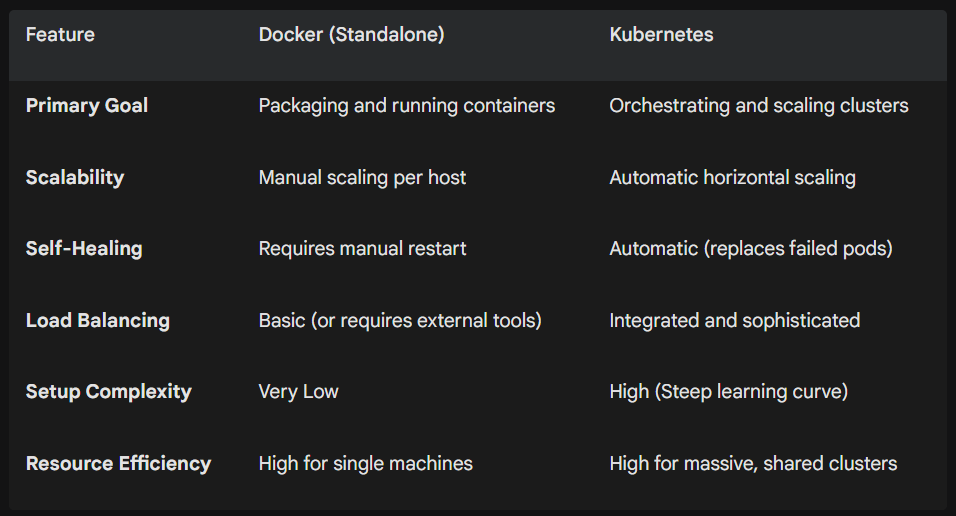
The "Docker vs. Kubernetes" Myth
You may have heard that "Kubernetes deprecated Docker." This is a technical nuance that is often misunderstood.
While Kubernetes moved away from using the full Docker Engine as its internal "runtime" (in favor of lighter standards like containerd), it still perfectly supports Docker Images. You will likely continue using Docker to build your apps, even if they are deployed onto a Kubernetes cluster.
When to Use Which?
Use Docker (or Docker Compose) when:
- You are a solo developer or a small team.
- You need to set up a local development environment quickly.
- Your application runs on a single server or has very low traffic.
- You want to minimize infrastructure costs and operational overhead.
Use Kubernetes when:
- You are managing a microservices architecture with many moving parts.
- High availability is a requirement (your app cannot go down).
- You need to scale resources up and down based on real-time traffic.
- You are operating in a multi-cloud or hybrid-cloud environment.
Conclusion: The Winning Combo
For most professional teams in 2026, the answer isn't "one or the other." The standard workflow is:
- Develop locally using Docker to ensure consistency.
- Orchestrate in production using Kubernetes to ensure reliability.
By combining the portability of Docker with the intelligence of Kubernetes, developers can focus on writing code while the infrastructure handles the complexities of scale and stability.