The choice of programming language in Web3 is no longer just about syntax; it is about choosing a security model and an entire blockchain philosophy. As we move into 2026, the landscape has bifurcated into the mature EVM ecosystem (Solidity), high-performance infrastructure (Rust), and asset-oriented security (Move).
1. Solidity: The Industry Standard
Solidity remains the "JavaScript of Web3." It was built specifically for the Ethereum Virtual Machine (EVM) and is the most widely adopted language for smart contracts.
- Paradigm: Object-oriented, high-level.
- Primary Ecosystem: Ethereum, Layer 2s (Arbitrum, Optimism, Base), Polygon, BNB Chain.
- Key Strength: Developer Mindshare. If you have a question, someone has already answered it on Stack Overflow. It has the most mature tooling (Foundry, Hardhat) and the largest library of battle-tested code (OpenZeppelin).
- The Catch: It is technically "brittle." Common pitfalls like reentrancy attacks and integer overflows (though improved in 0.8+) require rigorous auditing because the language doesn't natively "understand" that tokens are finite assets; it just treats them as numbers in a mapping.
2. Rust: The Performance Powerhouse
Rust wasn't built for blockchain, but its focus on memory safety and "zero-cost abstractions" made it the perfect fit for high-throughput networks.
- Paradigm: Multi-paradigm, low-level (systems programming).
- Primary Ecosystem: Solana, Polkadot (Substrate), NEAR, Cosmos.
- Key Strength: Speed and Safety. Rust’s "Ownership and Borrowing" model prevents memory-related bugs at compile-time. In Web3, this translates to high-performance "programs" (Solana's term for smart contracts) that can handle tens of thousands of transactions per second.
- The Catch: Steep Learning Curve. Rust is notoriously difficult for beginners. Concepts like lifetimes and the borrow checker can lead to "fighting the compiler" for days.
3. Move: The Asset-First Revolution
Move is the newcomer, originally designed by Meta (Facebook) for the Diem project. It was built from the ground up specifically to solve the security flaws inherent in Solidity and Rust.
- Paradigm: Resource-oriented.
- Primary Ecosystem: Aptos, Sui.
- Key Strength: First-Class Resources. In Move, an asset (like a token) is not just a variable; it is a "Resource." Resources cannot be copied, accidentally deleted, or double-spent by design. The Move Virtual Machine (MVM) uses a "Bytecode Verifier" to ensure these rules are never broken, even if the developer makes a mistake.
- The Catch: Fragmented Ecosystem. Move is still growing. While technically superior in asset safety, it lacks the massive library of third-party integrations and cross-chain tools found in the Solidity world.
Comparison Matrix (2026)
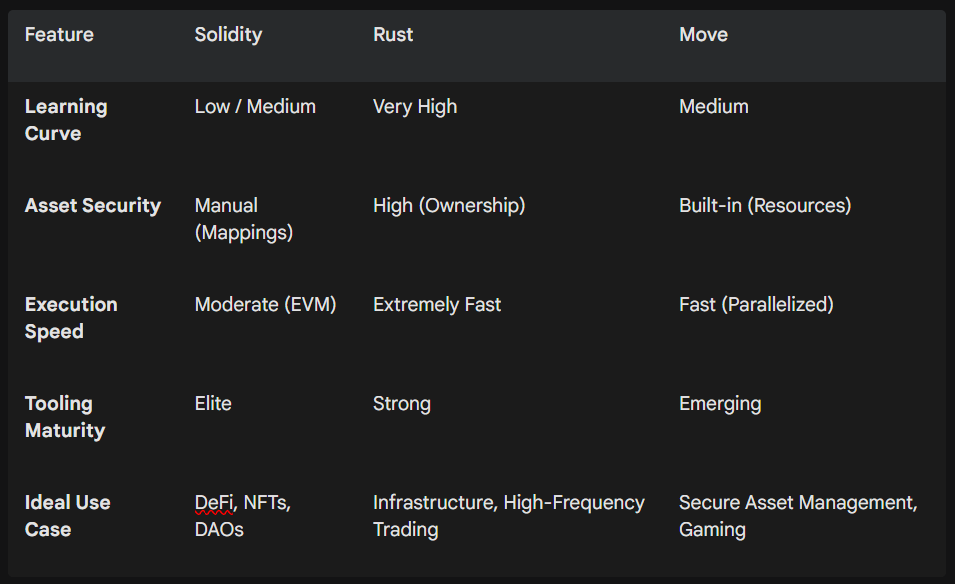
How to Choose Your Path?
- Follow the Money: If you want access to the highest Total Value Locked (TVL) and the most job opportunities, Solidity is the non-negotiable starting point.
- Follow the Tech: If you want to build the next generation of high-speed decentralized exchanges or complex infrastructure, master Rust.
- Follow the Safety: If you are building a protocol where asset security and formal verification are the top priorities, Move offers the most robust framework for the future.
Conclusion
In 2026, a versatile Web3 developer should ideally be "bilingual." Understanding Solidity provides the foundation for the broader market, while proficiency in Rust or Move prepares you for the high-performance, security-critical applications that are defining the next era of decentralization.